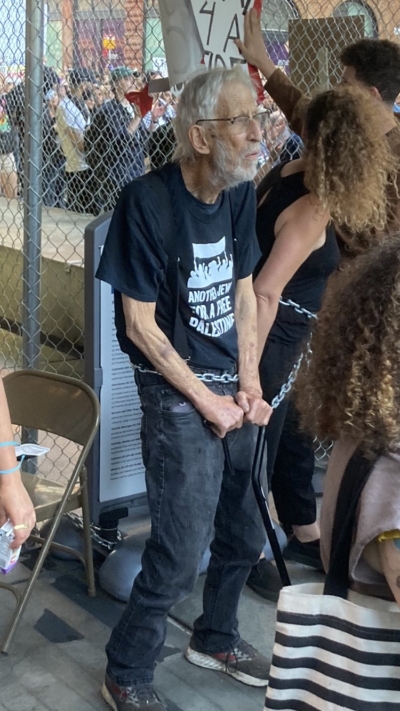
85 year old Osha Neumann, a MECA board member, chained to the Federal building in solidarity with Palestine
by Osha Neumann, MECA board member
In April 1989, the 14th months of the First Intifada, I arrived in Palestine as part of one of the first delegations led by MECA’s courageous and visionary founder, Barbara Lubin. We visited Ramallah, Jenin, Bethlehem, and other cities. We visited refugee camps and isolated villages set amidst ancient olive groves. In one village we met a woman who showed us where her husband’s blood still stained the wall of her living room. In the streets, wherever we went, we encountered crowds that were like surging rivers of pain and anger. In East Jerusalem’s Makassed Hospital, doctors lead us through the wards, stopping first at the bed of one patient after another. They held back the sheets so we could see the wounds Israeli soldiers had inflicted by beatings, by rubber bullets (actually steel balls with a thin coating of rubber) and by live ammunition. A boy told us how they methodically broke first his arms, then his legs.
Already shaken by what we had seen and heard, we crossed into Gaza. There we met with Palestinian doctors who drove us to Jabalia, a refugee camp that was, at least until this latest Israeli effort at ethnic cleansing, one of the most densely populated places on the planet. The camp was a warren of houses with concrete walls and tin roofs divided from each other by narrow alleys. It had been the scene of some of the most intense confrontations of the Intifada. For weeks at a time the Israeli army had imposed a total curfew, confining residents of the camp to their homes, 24 hours a day, on pain of death.
The doctors led us through the maze of alleys to a succession of small courtyards. From the courtyards doorways opened onto dark rooms that smelled of blood. In each room we met someone who told us what Israeli soldiers had done to them. Then they showed us their wounds. In the final room we met six Muslim women in Bedouin dress, lying on mats. Each one had been beaten. We gathered around them. Defying taboos, they begin to unwrap their black embroidered dresses to show us their arms, blue with bruises. One woman raised her hands, palms up, appealing to us in Arabic I could not understand.
Later, in an UNRWA clinic in the center of the camp, we met another group of Palestinian doctors. As we talked, a stream of ambulances unloaded men who had been wounded in the confrontations that were taking place around the perimeter of the camp. The doctors all seemed exhausted. They struggled to convey the difficulties they faced with the cascade of medical emergencies. It seemed as if all their energy was needed to maintain the objectivity of their profession in the midst of chaos that threatened that every moment to overwhelm them. One of the doctors, toward the end of their presentation, shared his effort to understand why Israeli soldiers treated Palestinians so brutally and the consequences for the Israelis of their brutality:
I’m afraid the Israeli soldier will become a sadist. They hit and they sing and laugh. Unfortunately, the Israelis were the victims of the Nazis. Now the Israelis are the offenders of the Palestinian people. This is a very bad thing. This is really a kind of disease. And when the soldiers attack, the others say, “Tov.” Tov means good. And they start to sing and to laugh. This is going to turn the soldiers into a kind of sadist people in the future. This is for their future as human beings not good. This policy is going to destroy the Israeli people in the future.
That doctor showed extraordinary empathy and foresight, in contrast to the Israeli doctors who, this November, called for the bombing of Al-Shifa hospital. His words are prophetic. What he feared has come to pass with the most terrible consequences. If I not visited Palestine, I could not have imagined what it is like to live under the suffocating weight of Israeli occupation, without rights the occupying power felt any obligation to respect, without protection from arbitrary detention and arrest, and with the constant threat of violence inflicted by the oppressor. One morning waking up in the Dheisheh refugee camp, I saw a little bird flying above the rooftops and thought “Here, only the birds are free.” That was then. Before Israel turned Gaza into an open-air prison, before repeated Israeli “operations” – murderous terroristic assaults on the civilian population, they describe with exquisite cruelty as “mowing the lawn.” Lawns do not bleed, nor do they weep for the dead and dying. And now it seems Israel has moved from mowing the lawn to tearing it up entirely, to ethnic cleansing, to the infliction on the long-suffering Palestinian people of a second Nakba. I cannot imagine what it is like now to be in Gaza. I can only vainly protest.
No! Our protests are not in vain. They are necessary. Through all, beyond imagining, Palestinians have been steadfast. We can be no less. Until Palestine is free none of us are free.