Today marks the second year anniversary of the Flour Massacre committed by Israeli forces and nothing has changed since then.
A field visit stirred my thoughts
MECA, in collaboration with our partners, continues to distribute relief parcels; including food parcels, bedding kits, hygiene kits, tents, flour, and clothes etc. We try our best to support families in Gaza as they continue to endure daily hardships.
When I arrived at one of our flour distribution points to document our work in Khan Younis, a strange, sudden feeling washed over me. I felt overwhelmed, but also somehow delighted, or maybe the right word is relieved.
At the beginning of the genocide, scenes like these of people waiting in line for flour would have devastated me. They would have left me furious because before this genocide, we still had some pieces of life. We were trying to create a sense of life by building some businesses and new projects, despite the Israeli blockade that had been suffocating us since 2007.
It is true that we had never known a truly peaceful life, but we had roofs over our heads.
At least people did not have to stand in endless lines for their basic needs, with death shadowing their every step.
A distant memory hit hard
As I was sitting on my chair looking at people taking their flour and others who still stood under the scorching sun waiting for their turn, a storm of nostalgia hit me recalling a memory when I was only 8.
Every morning, I used to get up early to wait for the taxi who would take me to my school.
My beautiful home was a residential building of 3 floors, and a terrace for family gatherings and barbecue nights. On the ground floor under our home was a large supermarket and a furniture store.
The supermarket used to open at 8 a.m., but the bakery that brought them bread began its day long before sunrise. By around 6:30 a.m., the bakers had already packed the bread, sending it out for delivery. When the delivery man reached the closed supermarket, he would leave the warm bags right at the doorstep.
I still remember standing nearby, breathing in that sweet, warm smell as I waited for the taxi, yet not once did I think of taking a piece. My mother always sent me after a full breakfast, with a lunchbox ready in my backpack.
No one was guarding the bread, no one was touching it. People were waiting until the supermarket employee arrived.
Back to the Harsh Reality
A woman’s voice pulled me out of my thoughts. She was telling another woman how excited she was to make pastries and manaqeesh when she would return to her tent.
I looked at the line and felt happy for her.
Then I realized how much Israel has forced me to normalize the line that I have always detested for its ugliness.
As the days passed in the genocide, I wished the suffering had stopped at “long lines.” But Israel kept pushing the boundaries of cruelty, inventing new ways to humiliate and break people, until even standing in line for bread felt like a dream.
I never imagined there would come a time when people would have to risk their lives every single day, just to bring “home” a little amount of flour. Then when the trucks finally appeared and a light of hope reached people who were starving, Israel would target them and commit bloody massacres that would be titled forever as the “flour massacres”.
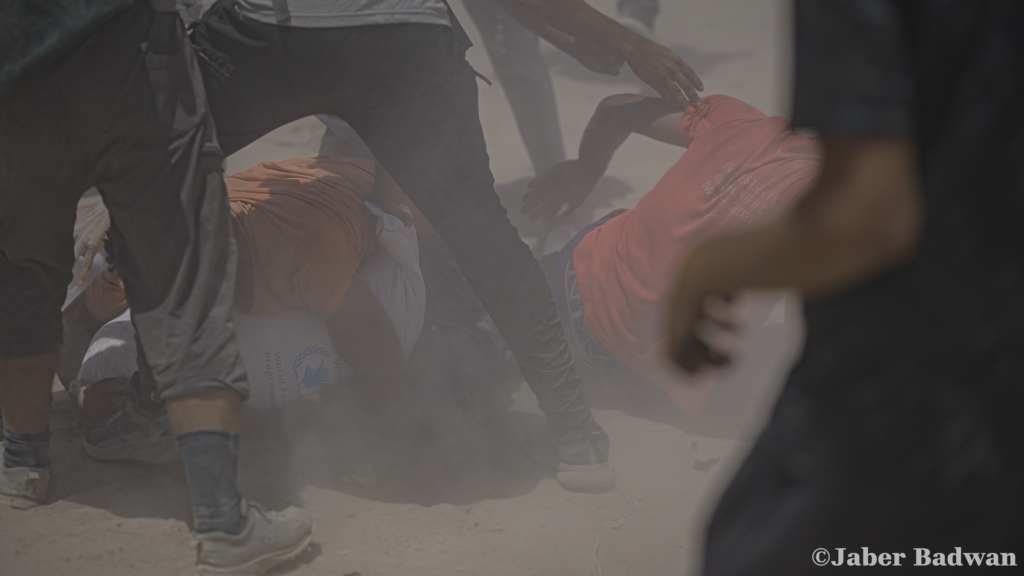
Today marks two years since the Al-Nabulsi Roundabout massacre, a memory I still cannot swallow. On 29 February 2024, Israeli soldiers opened fire on people already exhausted and consumed by hunger, waiting for flour for days, and deliberately slaughtered more than 112 Palestinians and injured hundreds more.
My mind keeps recalling images of people trying to survive and shielding their bodies. They would wait for hours before the aid trucks were permitted to move. During that time, they stood fully exposed, at constant risk of being fired upon, as Israeli tanks were positioned close to the crowds, then in a blink of an eye their lives were stolen and their blood was oozing out of their bodies.
Social media was flooded with cries of wives waiting for husbands who would never return, curses of mothers standing at the entrance of their tents with no sons left to come back, tears of children who hadn’t yet understood that they were now orphaned.
It was too cruel. Too ugly.
I spoke to one survivor, Ahmad, who described it as, “one of the most gruesome things I’ve experienced until this very day. There was fire coming from every direction and bodies were falling all around us. ”
He continued to say how going through this horror of risking his live to get flour didn’t even bring “success” for the survivors like him as most left empty handed. On his way home, he could see some people carrying torn bags of flour stained with the martyrs blood. “Was it worth it?” he found himself asking.
Death Traps and GHF
Another way Israel managed to kill starved, displaced Palestinians was through what became known as the GHF points, or what everyone in Gaza calls “death traps.”
My family lost one of its dearest members there; my cousin Ibrahim.
He had no real choice except to go to these death traps. He was a father of six, living in a tent at Mawasi, Khan Younis after being displaced seven times. With the famine worsening and no source of income since the start of the genocide, he was pushed into a fate no parent should face: risk his life to feed his children or watch them starve to death.
His four-year-old twins Hoor and Noor were always crying from hunger. They did not understand what famine meant or why their stomachs hurt. They did not know about the world’s silence or the monstrous military occupation behind all of this.
They just wanted food.
And Ibrahim, their gentle, loving father, had to bring that food despite the dangers.
He went to one of the deathtrap sites and never came back. A bullet shot him in his neck and killed him. After Ibrahim’s death, his eldest son, Abdullah, only 12, had to step into his father’s place and go on the same risky journey that his father went on, just to keep his family alive.
All continued until the crossings into Gaza partly-opened, food became less scarce, and Abdullah had a chance to think of his school again.
Our Responsibility. Take Action.
It was not one or two massacres, never was it three or four families. It was daily bloodshed for years.
Israel, backed by American mercenaries and other military and diplomatic support, deliberately created a famine in Gaza. First in the North in 2024, and second in 2025 in the rest of occupied Gaza. Israel deliberately closed all the crossings of Gaza and gave us no choice except going to death traps.
Now, somehow, I feel a strange relief. People are relatively safe, lining up for aid delivered to them by their fellow Palestinians in Gaza; instead of risking their lives. It’s surreal to feel joy over something that used to make me angry and heartbroken, but even our emotions have been reshaped by the endless pain we have faced.
This makes the humanitarian side of the so-called ceasefire all the more urgent. Israel must allow full, unconditional opening of all crossings and allow all essential aid in; food, flour, medicine, anesthetics, clothes, hygiene materials, building material, and everything people need to live and to Rebuild Gaza.
That is our call for you to take action. Our bodies have weathered, and our lungs can’t scream anymore, it’s on you to TAKE ACTION NOW!
The genocide is not over. The flour massacre did not happen again today, but there is a massacre nearly every single day.
Background information:
In October 2025, the US Administration announced the so-called ceasefire and presented a very long list of conditions divided into three phases. There were many conditions, among them, Israel was supposed to allow aid and goods to enter by semi-openning some of the crossings, stop firing at Palestinians, and withdraw from Gaza, all after having the Israeli detainees returned.
Israeli detainees are back to their families now, even their bodies were brought “home” at the cost of digging up and desecrating our graves. Other than that, not much has changed. There are still restrictions. There are martyrs everyday. There is bombing and more land stealing everyday. The second phase has been announced while the conditions of the first one remain just ink on paper.
And today, as Palestinians in Gaza are still dealing with the Israeli-manufactured famine’s consequences that continue to consume their bodies and souls; the fear of yet another famine is still looming in the near horizon. The prices of basic food items, which were already high, have doubled. And some food items have already disappeared from some markets across the Gaza Strip, like chicken and meat. As Israeli and American aggressions are expanding in the whole region, Palestinians in Gaza are haunted with fears of yet another famine.
It’s Ramadan now, a time that should be filled with shared meals, but hundreds of thousands of families have lost their sources of income and have no ability to provide for their families.
And as the region is targeted by yet another Israeli-American aggression, Palestinians as always bear the brunt, so once again all the crossing and borders into Gaza – that were only partially opened during the “ceasefire” – are closed once again. The Israeli blockade continues. The massacres continue. The genocide continues.