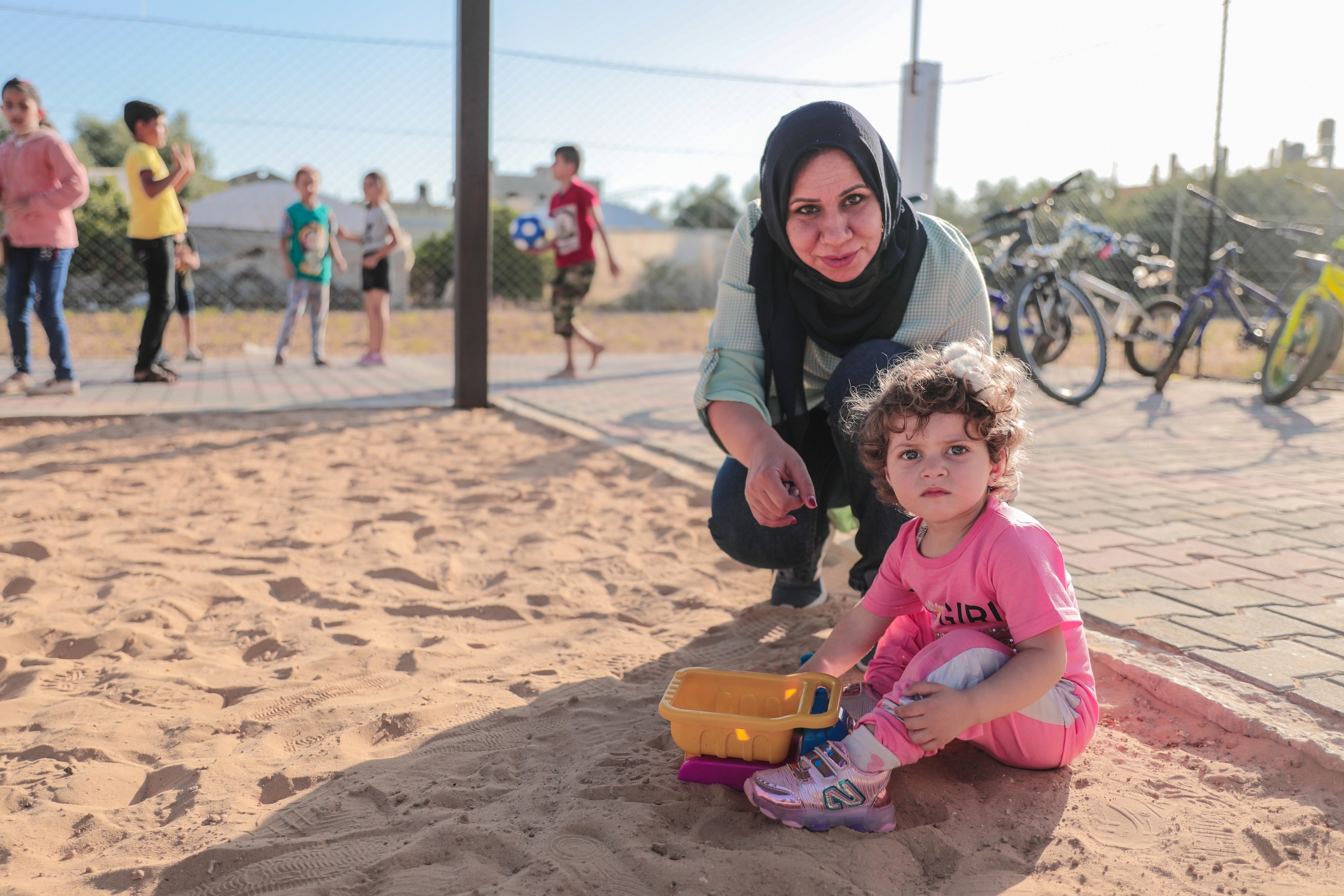
Wafaa with her niece
“Hey! I’m still alive! And luckily, I have internet I can speak with you!” Wafaa El-Derawi, MECA Nutrition Coordinator says, when I finally got through to her. She jokes, “We still have the same music playing in Gaza today. They are bombing everywhere but they have no rhythm. And everyone in Gaza is dancing because the land underneath us is always shaking.”
It may seem strange to people here, but when I feel the most down about what is happening in Palestine, I turn to people on the ground to pick me up. Even as they are experiencing the worst moments in their lives, even as the bombs are falling, they are hopeful and keep their sense of humor.
Wafaa lives in a house in the Gaza strip meant for 5-6 people. Now, there are 60 members of her extended family sheltering in their home, most of whom are children. She tells me “We are still lucky. We have some food in my home that we can share. Because we lost power, we cooked everything that needs refrigeration so as not to lose it.”
One of the people who came to stay is a 25-year-old man who is traumatized from the five wars he lived though in Gaza. His home was bombed in the 2014 attack while he was sleeping and he woke up in the street. Now, every time there is a shelling he goes into shock and cannot speak. Wafaa says, “All of us are traumatized from these wars, but some of us are more affected than others.”
Wafaa admits that she is scared like everyone else but the MECA work keeps her focused. “Our partners and volunteers in different areas of the Gaza strip want to support their communities. Despite the danger, they want to do this work because they know the people are in need.” While they are distributing food and other supplies, she waits anxiously until she hears that they have returned home safely. While we are talking, she suddenly lets out a scream and then pauses for a few seconds. She tells me she has heard massive shelling nearby, and I can hear her voice start to shake. I ask her if she wants to hang up, and she insists on continuing, explaining that “This is how we live.” Then her voice starts to crack as she tells me she is watching her neighbors grab a few things and leave.
After I hung up, I was really devastated and worried about Wafaa and her family. I turned back to the news. The screen of Al Jazeera is showing people leaving their houses, some running with their children. This kind of footage we witnessed in the previous attacks in Gaza, and so it feels like a nightmare on replay again and again.
Wafaa calls back and announces, “We decided. We are not leaving.” I can feel her voice is mixed–happiness and fear woven together. She says “My dad and I spoke with each other and my dad pushed that we shouldn’t leave.” He is a pharmacist, and wanted to keep the pharmacy open so people could access what medicine was left. She continues, “We decided together that we would all stay in the basement We hope it’s safe, but who knows. This is our luck. Because where will we go? They bomb schools, they bomb shelters. They bomb everywhere.” She continues, “We try to be strong all the time. It was the most difficult feeling when you think of leaving your house. The pain… like you are leaving and you won’t be able to come back. Maybe your home won’t exist.”
Then Wafaa tells me about her concerns for water. They are lucky to have a cistern under their house but because there is no power, they have to take the water out manually. She explains, “We try to be very careful because it will be impossible to refill it once it is gone. There is nowhere to buy water. This is it.”
Meanwhile, this expanded family prepares food together, eats together, laughs together, feels scared together, and children cry together. Wafaa says “By being together, even so crowded, we feel warm and care about each other. We support each other. We hug the children and keep them close to us. We survive because we are together.“ I can hear the sound of children around her while she is speaking. She explains that when the young children play, they get a few minutes to forget what is happening around them. They play for a few minutes, until the next shelling, when they run back to their parents overwhelmed with fear. We talk some more and then end the call hoping that the internet would stay up and that we’d be able to communicate again soon, but you never know.
I love how people in Palestine take care of children, how people are so connected to each other. It is different here in the USA, where everyone stays separated and individualism is the main way of life. While here we have basic necessities and plenty of extra things around, there they have each other. They live on this collective spirit, and on luck. Each family gathered together in the dark hope that they are not in the wrong place at the wrong time.
The last thing Wafaa said before we said goodbye was, “Hey, I’m not crying, I’m laughing now.” She was reassuring me by joking around. I told her she lifted my spirits. This is the part of the experience you cannot see on the news, through your screens. Despite the grave danger, people support each other and are committed to help and strengthen the community. This is survival. You feel it in them when they speak. Every time I speak with Wafaa I connect to this spirit, and I feel encouraged and energized until the next call.
I wish Wafaa and all people of Gaza, stay safe.
Until the next call with Gaza.