For the longest time, I believed that Israel has failed to achieve its aspirations of erasing us.
All these military checkpoints, towers, barbed wires, walls. All of these racist laws, regulations, policies. All of these military raids, detentions, torture. All of these Israeli flags scattered every two meters across all of Palestine, but especially in occupied Jerusalem and nearby illegal Israeli settlements in the West Bank. All of this death they surround us with; it’s all so they can segregate us from each other to dominate us and end our Palestinianness – ideologically and physically. And I thought they have failed, and their failure has kept me going all this time.
But sometimes I feel that perhaps these physical and bureaucratic colonial manifestations did succeed in turning us into “Gazans, West-Bankers, Jerusalemites, 48ers and those distant refugees and exiles” and that we are not a collective of Palestinians.
That feeling breaks me.
Then last week my colleague and I visited Tulkarem in the northern West Bank to see our partners and get to know new groups working for the benefit of Palestinian children and their families.
It was an extremely long day. We tried to visit and meet as many partners, people, and groups as possible since we never know when more arbitrary closures will be imposed by the Israeli military and/or settlers that will stop us from being able to reach each other. And even though it was an exhausting 14-hour long visit, when I got back home my heart was full, my mind was clear, my body was calm, and my faith in my people stronger than ever.
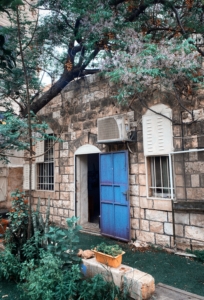
The garden at Dar Qandeel
We met with amazing colleagues working at Dar Qandeel for Culture and Art and had the honor of attending one of their creative art workshops with children. The workshop was hosted in their beautiful garden. Children come from multiple refugee camps and realities. It didn’t take us long to learn some of what these children have been through.
Part of the art exercise was asking the children to share what they wished was not part of their daily lives. Most of the answers were shared with shy smiles and hopeful eyes.
“I wish there were no more prisons.”
“I wish the wars would stop.”
“I wish I could spend every morning with my grandma and aunt like I used to.”
Every single child in the workshop was affected directly or indirectly by Israel’s brutality. There were children who have had loved ones detained violently in front of them, and they still remain in Israeli prisons until today – the same prisons where Israel recently legalized the death penalty against Palestinians, after decades of extrajudicial executions inside and outside of their different incarceration centers.
Children were forced to flee their homes in the many refugee camps in Tulkarem during the ongoing Israeli ethnic cleansing campaign in the West Bank that specifically targets refugee camps. They had to see their camps’ roads bulldozed and their homes either destroyed or taken over by the Israeli military turning them into military barracks. As they sought shelter elsewhere, some of these children were separated from family members, and denied the intermittent peaceful mornings with loved ones.
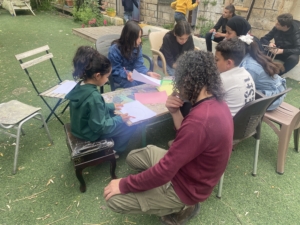 Yet the children were able to share such sorrows together in a group that felt like a hug of support. They were able to share their sorrows, their hopes, their laughs, and then take all of that and turn it into beautiful art. These art workshops aren’t merely a creativity exercise, they are a wholesome safe space.
Such space is important for the children and their facilitators as well. We saw firsthand how Rima, one of the facilitators, assisted the children in breaking their defensive walls and letting their inner artists out of their shells.
Rima is familiar with the reality these children are living, her family home is one of the few remaining houses in Tulkarem Refugee Camp. In order to reach it, we needed to walk through the destroyed streets of the camp with sewage overflowing from the damaged infrastructure, yet that did not distract us from the beautiful strawberry field alongside the way; owned by a Palestinian artist who came back home after years in Brazil in order to literally plant roots in his homeland.
If we continued a few meters past Rima’s home, on our right, we’d be met with an Israeli military barrack that used to be a small Palestinian factory. And at the end of the road, two huge Israeli military armored vehicles were in the middle of the bulldozed road of the camp.
Yet amid all of that colonial violence and structure; the second we went into her home, none of that mattered.
Palestinians have the ability to bring out beauty and sereness amid the most horrible situations, and this is not a romanticization of reality, it’s a fact on the ground. Rima’s home was warm and full of love. She welcomed us into her home, to share a meal with her and her lovely family because “we could not have come all this way and not have good food and some rest before heading back to Ramallah.”
She told us about the brutal Israeli invasion (days that turned into weeks, months, and now years). The ongoing ethnic cleansing, the economic hardships and every other horror in-between that Palestinians face. But even as she has shared some horrifying stories in her calm, warm voice, she also made us laugh. She talked of how her husband, a retired economy professor, used to lecture Israeli soldiers who detained him on how Zionism is just as bad for them as it is for us, and how after a while when Israeli soldiers did their “routine” rounds of detention and investigation, when they reached their home and saw him, those soldiers who recognized him would say, “no no leave him, we’re good.” To this Rima laughed, “I guess they’re not interested in a good education from my husband…”
This comic relief doesn’t obscure the horrors, but as Mohammed el-Kurd describes this laughter is “an act of refusal and a way to construct an alternative reality where wounds are less painful, rather than just a way to cope.”
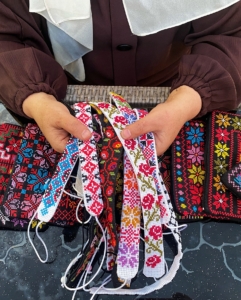 Rima’s home was close to al-Awda center where we were able to meet up with some of the team behind “Palestinian Grandma,” one of the artisan groups we work with for our online shop. This group works on providing the material, equipment, and work conditions needed for 35 Palestinian women from Tulkarem and surrounding refugee camps to do their traditional crafts, mostly embroidery, that helps these women support themselves and their families.
What made the interaction with them all the more heartwarming, was how they – organically – told us the story of each piece and made sure to attribute it to the woman whose hands embroidered it.
They showed us this intricate colorful piece of embroidery with such vibrant patterns and said, “You see this beauty? This was made by a woman from Tulkarem’s refugee camp who has been internally displaced not once, but twice.” They didn’t have to finish the sentence as all of us standing there already knew what the rest of the sentence is, “and yet, despite all of the hardships she’s faced she was still able to produce such vibrant beauty.”
This is what I mean when I said as Palestinians, we’re able to bring out beauty in the most ugly situations. When we say a woman from a refugee camp has been internally displaced twice, it doesn’t just mean her loss of a home. It also means she’s been subjected to militarized violence, that the men in her family would have likely been detained and interrogated, if not the women and children as well, that some of them are probably still detained.
And it means she has been forced to live in overcrowded places with the hope that she’ll be able to return to her home again. Not even her original home since she’s a refugee whose family was already forcibly displaced from their original home in 1948’s Nakba.
All of what I’ve shared above is merely a few details of the intense visit we had. I wish I could tell you every single detail of that trip.
Going back to Ramallah and Jerusalem after that long day, even though we had to take several detours because Israeli soldiers and settlers closed many of the main roads we used to use as Palestinians, and even though we had to see hundreds of Israeli flags all over our roads across the West Bank, and even though we lost count of how many checkpoints we crossed – and still, I’ve never felt more at home and at peace.
Israel did not succeed in keeping us apart, they did not succeed in erasing our Palestinianness.
They pushed our friends outside of Gaza? We will visit them wherever they go in exile. They’ve multiplied by the hundreds their roadblocks and checkpoints to stop us from reaching each other, we will keep finding one detour after the other even if it means spending hours on the road. They’ve created conditions that will only turn people into monsters, and yet our people have met all of that ugliness and disparity with such serenity, beauty and laughter refusing to surrender to their occupier’s conditions.
The reason that children who’ve been through the unimaginable are still able to smile and produce such beauty as we’ve seen during the Dar Qandeel art workshop, is because these workshops are run by amazing Palestinians who understand the children’s realities.
They know not only what these children have been through, but also the untold stories of their families hardships of displacement, loss, and detention by Israel’s violence. Same as the amazing team from Palestinian Grandma who knows the story of the women behind each beautiful embroidered piece. And that’s what MECA’s work with our partners is all about. We invest in those who know best what their communities and children need. We invest in those who refuse to give up even when everything around them is getting worse. We invest in those who refuse to abandon their land and their people, and we will continue to.